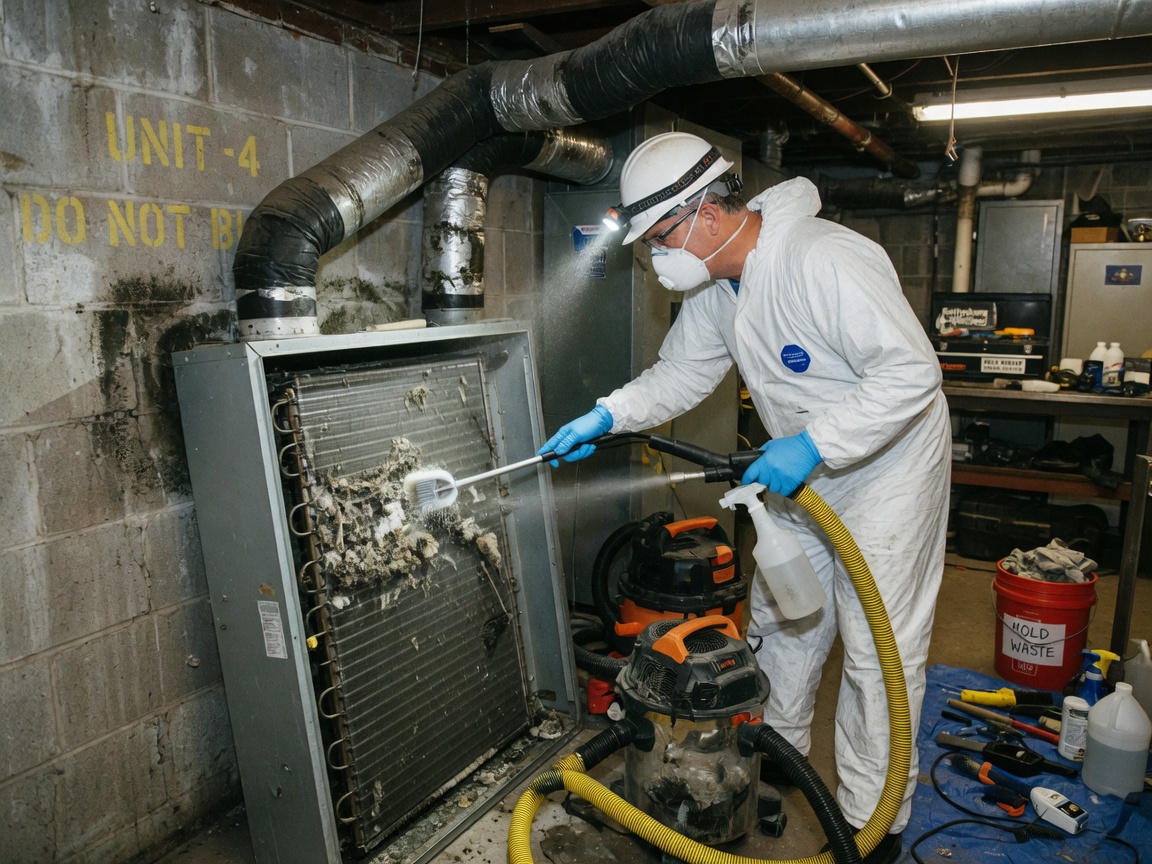
In Gettysburg’s humid continental climate, warm summers drive high indoor humidity while cold winters create condensation inside metal ducts and on evaporator coils. Homes in Historic Gettysburg and around Gettysburg College often have original or early-replacement duct runs that trap moisture against uninsulated walls, allowing mold to colonize supply and return lines. Technicians must isolate the system, use HEPA-filtered negative air, and treat coils without damaging historic plaster or woodwork common in these neighborhoods.
Barlow Knoll and properties bordering Gettysburg National Military Park sit on slightly rolling terrain that can channel runoff toward foundations during heavy spring rains. When crawl-space or basement air is pulled into the HVAC, spores travel through the entire duct network. Cleaning requires mapping each branch, removing visible growth with EPA-registered antimicrobials safe for occupied spaces, and verifying clearance with post-remediation air sampling before restoring airflow.
Nearby Hanover and Carlisle homeowners sometimes bring in systems with mixed metal and flex duct that complicates full access. In Gettysburg we open only the necessary registers and boots, then reseal with mastic rather than tape so the repair holds through freeze-thaw cycles. This approach prevents re-contamination while keeping disruption low for families living close to the Eisenhower National Historic Site and battlefield trails.
Technician insight
In Gettysburg, the thing that catches most people out with HVAC Mold Cleaning is hidden moisture trapped where uninsulated ducts run along north-facing walls in winter; the cold metal pulls humidity from the house and feeds mold for months before anyone notices musty air coming from the registers.
Condensation in a Barlow Knoll Cape
A 1958 home near Barlow Knoll showed musty smells each January. Inspection found heavy growth on the return plenum where cold ductwork met an uninsulated foundation wall. We isolated the system, removed the growth, treated the coil, and added mastic seals. The homeowners reported clear air through the next freeze-thaw cycle.
HVAC Mold Cleaning Services We Offer
✓Ductwork Mold Removal
Full trunk and branch cleaning in older Gettysburg homes where flex duct meets rigid metal runs.
✓Evaporator Coil Sanitization
Deep cleaning of A-coils that collect condensation during humid Adams County summers.
✓Return Air Plenum Treatment
Removal of mold from large return boxes common in 1940s–1960s homes near the Battlefield.
✓Register and Boot Cleaning
Targeted service for floor and wall registers that trap spores in Historic Gettysburg properties.
✓Whole-System Fogging
EPA-approved fog application after mechanical cleaning to reach hidden surfaces in Carlisle-style duct layouts.
HVAC Mold Cleaning Cost in Gettysburg, PA
| Service | Typical Range | What Affects It |
|---|---|---|
| Single-story duct cleaning | $450–$750 | Standard Gettysburg homes with accessible trunks |
| Two-story or complex duct cleaning | $700–$1,100 | Historic properties with multiple returns |
| Evaporator coil cleaning only | $250–$400 | When ducts test clean but coils show growth |
| Full HVAC fogging add-on | $150–$250 | After mechanical cleaning in high-humidity seasons |
Ranges are typical for Gettysburg, PA and confirmed with an exact written quote before any work starts.
How it works
- 1
Visual and Borescope Inspection
Technicians examine accessible ducts and coils, noting moisture sources tied to local weather patterns.
- 2
Containment and Negative Air Setup
Plastic barriers and HEPA machines isolate the HVAC from living spaces in tight Gettysburg lots.
- 3
Mechanical Removal and Antimicrobial Application
Brushing, vacuuming, and treatment of coils and ducts without damaging historic finishes.
- 4
Drying Verification and Clearance Testing
Moisture meters and air sampling confirm the system is dry before reassembly.
- 5
System Restart and Homeowner Walkthrough
Filters are replaced and owners shown how to maintain airflow through seasonal humidity swings.
Pricing
Cost depends on number of runs, coil condition, and whether flex duct must be replaced.